Learning and sharing knowledge through international projects
During the exchange, Luka contributed to two ongoing Erasmus+ projects: GreenCraft, which develops young people’s green, digital and entrepreneurial skills, and EmpowerHERment, an adult education project.
One of his tasks within GreenCraft was to prepare educational materials on e-commerce. Luka researched the topic, prepared a presentation and explained the steps involved in starting an online business. He then presented this material at an online seminar attended by more than 60 people.
“During the seminar, I provided practical guidance on identifying target customers, choosing online sales channels and using digital marketing strategies,” Luka explains.
Preparing the seminar required him to explain the process of starting a business in a way that would help participants understand where to begin and what decisions to make. It was an opportunity to apply his knowledge to developing educational content and working with an audience.
Alongside these tasks, Luka searched for international partners, communicated with academic and other organisations, and learned to develop project concepts and proposals. The work involved analysing needs, setting objectives, planning activities, allocating responsibilities among partners and defining expected outcomes.
Developing an adult learning project
During the exchange, Luka also began developing AI LearnPath Europe, a project concept he initiated independently. It aims to improve access to adult education through artificial intelligence, personalised learning pathways and short learning modules.
Particular attention will be given to adults with limited digital skills, older learners and people facing barriers to lifelong learning.
“I initiated this project concept independently. I analysed educational challenges and needs, formulated objectives, defined target groups, planned activities and expected outcomes, and researched potential international partners,” L. Epadze explains.
AI LearnPath Europe is still under development. Luka aims to prepare a proposal for the 2027 Erasmus+ funding call.
The initiative connects his interest in technology with a specific educational question: how to make learning more accessible to people who find digital tools difficult to use. Developing the concept allowed him to apply the project planning principles explored during the exchange to his own idea.
A mentor became a business partner
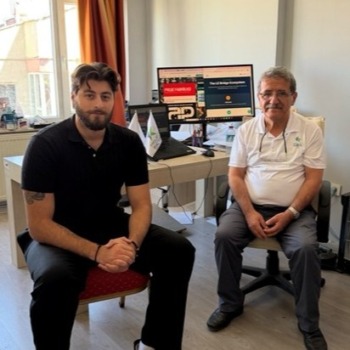
Luka’s host, Project Factory founder Ali Ulusoy, works in European projects, education, social innovation and entrepreneurship. During the exchange, the two regularly discussed project ideas and reviewed proposals in progress.
Luka emphasises that learning from someone with many years of business experience was one of the most important aspects of the exchange. Working together enabled him to discuss decisions with his mentor and apply his feedback to specific tasks.
Their collaboration eventually took a new form. Together, they established UAB LE Bridge in Lithuania.
“LE Bridge is a company I co-founded in Lithuania with my Erasmus for Young Entrepreneurs host, Ali Ulusoy. Our main activities will focus on European project development, Erasmus+ funding consultancy, international partnership building and digital transformation,” Luka explains.
Ali Ulusoy, in turn, highlights Luka’s willingness to learn and his contribution to the organisation’s work.
“Luka was respectful, hardworking, curious and willing to learn. He contributed actively to project development and partner research, and the creation of LE Bridge shows how an EYE exchange can lead to a concrete entrepreneurial result,” says Ali Ulusoy.
Helping organisations prepare for European projects
LE Bridge plans to work with universities, non-governmental organisations, educational institutions, associations and small and medium-sized enterprises. Its services will include identifying funding opportunities, preparing project proposals, selecting international partners and managing projects.
The founders aim to support organisations that lack experience in applying for EU funding, resources for project development or connections with potential partners abroad.
“We want to help organisations identify EU funding opportunities, develop competitive project proposals, find international partners and manage European projects,” says L. Epadze.
Within the company, Luka will focus on identifying and communicating with potential partners in Lithuania and other European countries, developing project concepts and proposals, and coordinating local activities. Ali will contribute his extensive experience in project development and management, international connections and advice.
In the near term, the company plans to expand its partner network, strengthen its online presence, organise practical Erasmus+ workshops and arrange meetings for potential partners. Preparing for the 2027 funding calls is one of its main priorities. The founders plan to develop joint projects and educational initiatives in cooperation with Project Factory.
A clearer direction while still at university
Luka travelled to Türkiye to gain a better understanding of international project development. He now sees this work as part of his professional future and the company’s plans. Together with Ali, he intends to strengthen cooperation between organisations in Lithuania, Türkiye and other European countries, particularly in education, digital transformation, entrepreneurship and social innovation.
“In the longer term, we aim to establish LE Bridge as a reliable partner for European cooperation and digital innovation,” says Luka.
He is pursuing this goal alongside the person from whom he learned about business. The professional relationship that began during the exchange will continue as they share responsibility for running their company. Luka will now combine his studies with the tasks involved in starting an independent business.
“This experience gave me more confidence, practical skills, knowledge and a much clearer vision for my future as an entrepreneur,” says L. Epadze.
Luka is convinced that without the Erasmus for Young Entrepreneurs programme, neither the international connections nor the joint company would likely have come into existence. His story demonstrates that participation in the programme can become not only a source of professional experience but also a genuine springboard to starting one’s own business.
For more information about Erasmus for Young Entrepreneurs and the EPIC Entrepreneurs Promoting Innovative Change project, contact Prof. Dr Rūta Čiutienė at ruta.ciutiene@ktu.lt.